
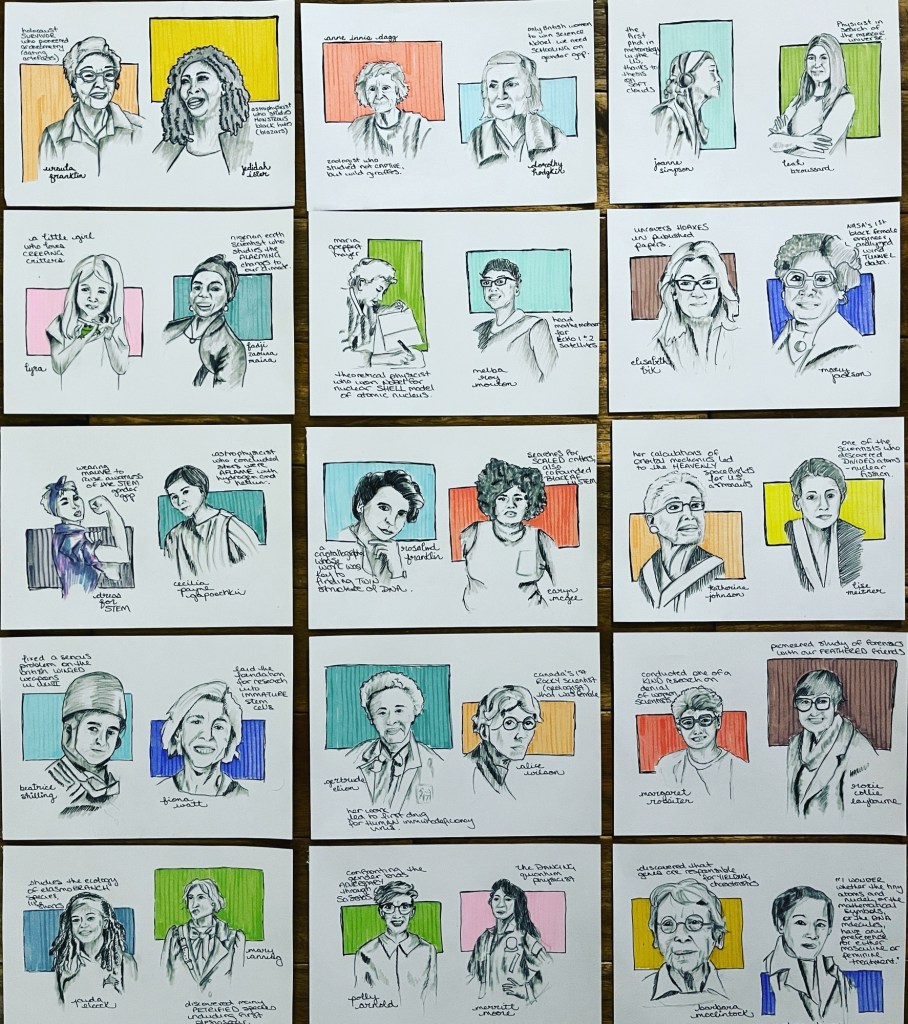
To help me focus for the 2022 challenge, I decided that I needed a theme underpinning all 30 words – ultimately choosing “women in STEM”.
With September being “back to school” for our family, it was likely that evenings would be busy with new activities and old routines. To adapt for these challenges, I started with a trace of a photo to get the general facial shape and rough placement of eyes, nose, and mouth. Then, I used a reference photo to draw shadows and shapes in pencil. Once that’s done, I went over the main outlines in a black Sharpie, and used a bit of my trusty light grey Midliner for additional shadowing. I finished with a bold comic-like background in a Midliner colour, and added the name and a little blurb about the scientist.
Space: The Final Frontier
I’ve always preferred chemistry to physics, so it was fun to learn more about outer space. I read about the first African American woman to receive a PhD in astrophysics at Yale, Dr. Jedidah Isler, and her study of black holes called blazars (Day 2: Monstrous), Dr. Leah Broussard’s investigations into portals to other dimensions (Day 5: Mirrored). I learned about Dr. Cecilia Payne Gaposchkin’s doctoral thesis that proposed stars were made of hydrogen and helium (Day 13: Aflame).
And it would not have been a complete list of women in physics without representation from “hidden figures”: Melba Roy Mouton, who led the “human computers” who tracked the Echo 1 and 2 satellites’ trajectories (Day 10: Echoing), and Katherine Johnson, the first African-American woman to work for NASA, and who was key to the success of manned space flight (Day 17: Heavenly).
Atomic
Dr. Goeppert Mayer shared the Nobel in 1963 for describing the shell model. Her thoughts? “Winning the prize wasn’t half as exciting as doing the work itself.” (Day 9: Shell)
Lise Meitner was one of the scientists who discovered nuclear fission and the element Pa – protactinium. Scarce on Earth and ☢️, it has no uses outside research. (Day 18: Divided)
Merritt Moore is a quantum physicist and also an American ballerina – I love that (and imagine knowing about physics helps with the art form?) (Day 28: Dancing)
And it made sense to finish with Chien Shiung Wen (Day 30: Wonder) and her epic quote:
“I wonder whether the tiny atoms and nuclei, or the mathematical symbols, or the DNA molecules have any preference for either masculine or feminine treatment.”
I Wanna Rock n’ Roll
In university, I avoided physics by taking geology, and ended up enjoying the puzzle solving aspect of it. I learned about Holocaust survivor Ursula Franklin, who pioneered archeometry, or the science of dating artefacts (Day 1: Survivor). Canada’s first female geologist, Alice Wilson, wasn’t allowed to go on field expeditions with men (Day 23: Rocky), so she travelled by herself for her 50 year career studying the Ottawa-St. Lawrence Lowlands. Her work is still a respected source of information to this day. Across the pond and a century earlier, Mary Anning discovered a deep fossil record along the English Channel cliffs that changed knowledge of the prehistoric record (Day 25: Petrified).
Zoology
The first Western researcher to study giraffes in the wild (not Captive – Day 4), Dr. Anne Innis Dagg is a Canadian zoologist who was denied tenure because she was married. This sparked her feminist activism, but was still largely unknown until a documentary featured her work in 2010. Roxie Collie Laybourne pioneered the field of forensic ornithology, studying over 1000 bird strikes each year to improve aircraft safety. (Day 24: Feathered).
Two PhD candidates also featured here. Earyn McGee studies the impacts of climate change on lizards in Arizona, as well as cofounded a black women in STEM group (Day 16: Scaled). Jaida Elcock works on their PhD to learn about elasmobranches, a group of animals that includes sharks (Day 26: Branching).
Chemistry
The only British woman to receive a Nobel Prize for a science, Dr. Dorothy Hodgkin discovered the structures of insulin, penicillin and vitamin B12 through X-ray crystallography. She received her schooling in England, but also lived in North Africa and the Middle East due to her parents’ work. Polly Arnold is a queer chemist who advocates against the adversaries to minority scientists (Day 27: Adversary)
Here Comes The Rain Again
Dr. Joanne Simpson contributed significantly to meteorology, studying tropical weather as the field’s first PhD in the US (Day 6: Soft). Dr. Fadja Zaouna Mouna is a hydrologist @NASAGoddard studying the alarming impacts of climate change on water supply (Day 7: Alarming).
Private Eyes Are Watching
To check that those stories were above-board, Dr. Elisabeth Bik hunts down hoaxes and frauds in published papers; specifically, alterations in images and figures. (Day 11: Hoax)
Winds of Change
NASA’s 1st black female engineer, Mary Jackson studied wind tunnel data to improve US planes (Day 12: Tunnel)
Beatrice Shilling was an aeronautical engineer who identified and fixed the problem that caused some of Britain’s WWII planes to stall in the air. (Day 19: Winged)
Twisted Sisters
One of the best-known examples of a woman scientist wronged, Rosalind Franklin’s crystallography work was key to understanding numerous structures – not the least of which was the double-helix of DNA. (Day 15: Twin)
Fiona Watt’s work in the 80s laid the groundwork for stem cell research, which has had massive implications in understanding cancer. (Day 20: Immature)
Gertrude Elion’s work led to the creation of AZT, or azidothymidine, an anti-retroviral that was a game-changer for treating HIV infection. (Day 21: Human)
Barbara McClintock’s work expanded on genetics by studying corn and what harvests would bring (Day 29: Yielding)
 campfire notebook.